THINGS TO DO
Support Choose Love and buy real products for refugees. SUPPORT HERE
Help Ukrainian women and girls via UN Women who are working to address the burgeoning needs of women and girls.
DONATE HERE
Read about the Five Ways You Can Support Ukraine
HERE
Find a Goal 16 charity you want to support. Any donation, big or small, can make a difference!
Speak up! Ask your local and national authorities to engage in initiatives that don’t harm people or the planet.
Know your rights at work. In order to access justice, knowing what you are entitled to will go a long way.
Vote! Take advantage of your right to elect the leaders in your country and local community.
Run for a public post.
Stay informed. Follow your local news and stay in touch with the Global Goals online or on social media at @TheGlobalGoals.
2024 Report
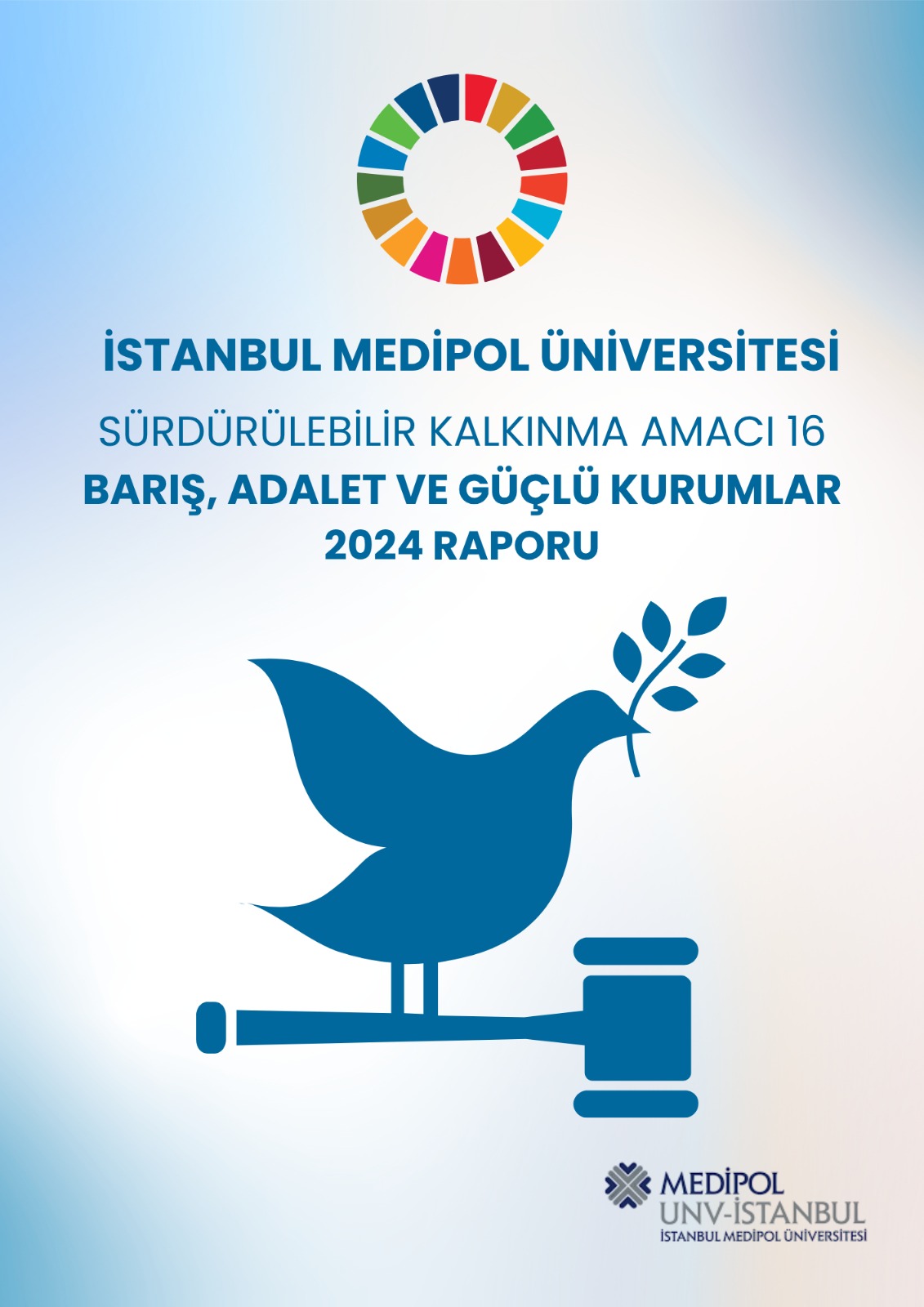
Istanbul Medipol University‘s Commitment to SDG 16
Peace, Justice and Strong Institutions
Istanbul Medipol University is committed to promoting strong institutions, ethical governance, transparency, and a culture of peace within its academic community and through its contribution to society. Guided by SDG 16, the University upholds principles of justice, accountability, human rights, and equality as core institutional values.
Medipol ensures fair, transparent, and inclusive institutional processes supported by ethical guidelines, quality assurance mechanisms, and accountable governance structures. Policies promoting anti-discrimination, equal opportunity, and safe campus environments safeguard the rights and well-being of students and staff.
The Office of Ombudsman of Anti-Discrimination and Equality and related institutional units provide channels for reporting, mediation, and resolution of disputes, ensuring confidentiality, fairness, and access to justice in institutional practices.
Through academic programs, research, and community engagement activities, the University contributes to awareness and development in areas such as law, governance, human rights, social justice, and democratic participation. Initiatives foster civic responsibility, ethical leadership, and active citizenship among students.
Partnerships with public institutions, NGOs, and international organizations support projects that promote social justice, peace education, and community well-being. Student involvement in volunteerism, social contribution, and advocacy initiatives strengthens a culture of respect, dialogue, and mutual understanding.
By integrating SDG 16 into institutional policies, education, research, and community outreach, Istanbul Medipol University reaffirms its commitment to fostering peaceful, inclusive, and accountable institutional environments for all.
Elected Representation and Inclusive Decision-Making
The University Senate, Medipol’s highest academic and administrative decision-making body, includes 33 members representing every faculty and school. Elected faculty members, deans, institute directors, and vice-rectors serve under the leadership of the Rector.
This participatory structure ensures that major decisions such as academic programs, ethical guidelines, and strategic priorities, are discussed collectively. Students also take part through the Student Council and sustainability committees coordinated by SURKAM.
Through this model, Medipol advances inclusive governance and democratic accountability across all institutional units.
Related Links & Reports:
Ethics, Integrity, and Anti-Corruption Commitment
Istanbul Medipol University enforces a zero-tolerance policy against bribery, corruption, and organized crime. The University operates under a comprehensive Ethics and Management System, comprising five independent Ethics Committees and a Research Ethics Board.
All ethical principles and disciplinary procedures are publicly available on the University website. Regular training sessions on integrity, data privacy, and responsible conduct reinforce the institutional culture of honesty and accountability. These efforts reflect Medipol’s dedication to building a fair and transparent academic environment. The University’s ethical framework is governed by five independent Ethics Committees operating under the Office of Research Ethics Committees, ensuring compliance with national and international standards. These include:
- Local Ethics Committee for Animal Experiments
- Non-Interventional Clinical Research Ethics Committee
- Social Sciences Scientific Research Ethics Committee
- Clinical Research Ethics Committee
- GETAT Clinical Research Ethics Committee (Traditional and Complementary Medicine)
These committees review research proposals, ensure the protection of human and animal subjects, and uphold ethical integrity in all research activities. Additionally, Medipol’s Management System Policy defines institutional principles on ethical behavior, conflict of interest, and transparency.
Related Links & Reports:
- Research Ethics Committees & Policies
- Istanbul Medipol University Animal Experiments Local Ethics Committee Directive
- Istanbul Medipol University Directive on Non-Interventional Clinical Research Ethics Committee
- Istanbul Medipol University Directive on Social Sciences Scientific Research Ethics Committee
- Istanbul Medipol University Clinical Research Ethics Committee Directive
- Istanbul Medipol University Traditional and Complementary Medicine Practices Clinical Research Ethics Committee Directive
Academic Freedom and Institutional Autonomy
Academic freedom is a fundamental institutional value at Istanbul Medipol University, ensuring that all faculty members and researchers have the right to determine their research areas, express their scientific opinions, and publish findings freely within ethical and legal frameworks. This principle is safeguarded through the University’s Research and Development Policy, which promotes innovation, interdisciplinary collaboration, and independent inquiry across all academic disciplines.
In exercising these freedoms, Istanbul Medipol University adheres not only to its internal ethical standards but also to the Ethical Conduct Principles of the Council of Higher Education (YÖK), which serve as a national reference document regulating ethical behavior across Türkiye’s higher education system. These principles define the responsibilities of academic staff in maintaining honesty, impartiality, and academic integrity while preventing plagiarism, discrimination, and conflicts of interest.
The integration of YÖK’s Ethical Conduct Principles into Medipol’s research and governance policies ensures that all scientific and scholarly activities align with national and international norms of transparency, responsibility, and freedom of expression. To maintain the independence of scientific research, the University operates five autonomous Ethics Committees under the Office of Research Ethics, which oversee compliance with both YÖK regulations and institutional ethical frameworks.
These committees guarantee that teaching and research activities uphold the highest standards of integrity and respect for academic freedom. Furthermore, open-access publication practices, intellectual property rights, and fair evaluation mechanisms reinforce the culture of scholarly independence. Through the coordination of SURKAM (Sustainable Development Application and Research Center), Istanbul Medipol University continually monitors and reports its efforts to uphold academic freedom within the context of SDG 16 (Peace, Justice, and Strong Institutions).
Financial Transparency and Accountability
Financial and performance indicators are published annually in the Institutional Internal Evaluation Report and on the University’s public website. The report includes strategic goals, budget allocations, and performance outcomes consistent with the YÖKAK Quality Assurance Framework.
By openly sharing institutional data, Medipol ensures accountability to stakeholders and the public while promoting a culture of fiscal responsibility and evidence-based management. All financial transparency measures are reviewed and validated within internal and national quality assurance processes.
Related Links & Reports:
Students’ Council at Istanbul Medipol University
Istanbul Medipol University formally recognises an independent Student Council as the central representative body of all students. The Council is elected through a transparent and democratic process regulated by national legislation and the University’s Student Council Directive. As an autonomous structure, it operates independently from university administration in its decision-making, prepares its own activity agenda, and represents students in institutional committees, including quality assurance, education commissions and faculty boards.
The University supports the Council’s autonomy by providing meeting spaces, administrative access, and regular consultation mechanisms while ensuring that student representatives actively contribute to governance, feedback processes, and policy development. This structure guarantees meaningful student participation and strengthens democratic culture across campus.
Related Links & Reports:
Policies and Procedures for Local Stakeholders
Istanbul Medipol University has established comprehensive written policies and procedures that regulate the identification, mapping, and engagement of local stakeholders. These procedures are embedded within the University’s Quality Assurance Framework and the Social Contribution Policy, ensuring structured collaboration with municipalities, public institutions, NGOs, schools, healthcare providers, professional chambers, and community organizations.
Stakeholder mapping is conducted systematically through needs assessments, community analyses, and annual planning processes managed by the Quality Coordination Office and SURKAM (Sustainable Development Research and Application Center). Engagement mechanisms include joint projects, advisory meetings, community outreach activities, internship and volunteering networks, and thematic working groups.
These written policies ensure transparent, inclusive, and accountable interaction with local stakeholders, enabling the University to contribute meaningfully to social development, community well-being, and the broader SDG 16 agenda.
Mechanisms for Local Stakeholder Participation in University Decision-Making
In addition to its structured stakeholder-engagement procedures, Istanbul Medipol University ensures that local stakeholders including community residents, municipal authorities, civil society organizations, and groups working with vulnerable populations such as refugees, have meaningful mechanisms to participate in university decision-making processes. This participation is facilitated through stakeholder consultation meetings, advisory boards, joint working groups, public engagement sessions, and collaborative planning platforms established for education, health, sustainability, and social contribution initiatives. Feedback collected through these mechanisms is formally integrated into institutional improvement processes managed by the Quality Coordination Office. Through these participatory structures, the University promotes transparency, inclusiveness, and shared governance in line with the principles of SDG 16.
Related Links & Reports:
Expert Contributions to Public Policy
Istanbul Medipol University actively contributes to national and local policymaking through academic expertise, public consultations, and formal collaborations with governmental bodies. In line with its commitment to justice, good governance, and evidence-based decision-making, the University provides structured expert advice to ministries, local administrations, and regulatory institutions.
Through its Faculty of Law, Department of Political Science and Public Administration, and affiliated research units, Medipol delivers academic guidance in constitutional law, human rights, administrative governance, tax law, and public sector reform. High-level symposiums, panels, and policy workshops enable the University to share scholarly findings directly with public authorities.
A key example is the national symposium “Devletin Teminatı Olarak Anayasa Yargısı”, where academics, judges, and policymakers discussed judicial independence, constitutional review, and the rule of law. The official symposium proceedings demonstrate Medipol’s role in informing policy debates with scientific analysis.
The University also contributes expert opinions to ministries and local governments through joint projects, advisory committees, and governance-focused research. Annual events—such as the Tax Law Symposium—as well as ethics committees and human-rights–oriented research groups provide continuous evidence-based insights for public policy development.
Through these integrated activities, Istanbul Medipol University serves as both a center of academic excellence and a strategic partner contributing scientific expertise to national and local decision-making processes.
Related Links & Reports:
Capacity Building Programs for Decision-Makers
Istanbul Medipol University strengthens the capacity of policy-makers, public administrators, legal professionals, and civil society actors through a comprehensive ecosystem of education, research, and stakeholder engagement aligned with SDG 16. Throughout 2024, faculties, research centers, and student-led units jointly delivered a wide range of programs that support evidence-based policy-making, ethical governance, human rights protection, and participatory decision-making.
Strengthening Legal and Public Policy Competencies
A major component of Medipol University’s contribution to SDG 16 is its structured capacity-building activities directed at legal and administrative decision-makers. Key events include:
- “State Guarantee of Constitutional Jurisdiction” Symposium – providing in-depth analysis on judicial independence, constitutional checks-and-balances, and rule of law frameworks.
- “Administrative Ethics and Law in Public Service Delivery” Panel – supporting public administrators in accountability, transparency, and ethical decision-making.
- “Pushbacks Against Refugees and Irregular Migrants” Panel – informing migration officials, legal practitioners, and NGOs about international legal obligations and human rights standards.
- “On the Path to Justice: Human Rights and Implementation” – strengthening the knowledge of human rights professionals on current international norms and enforcement mechanisms.
These activities directly enhance the competencies of judges, lawyers, public administrators, and policy implementers by providing current legal knowledge and ethical frameworks essential for democratic governance.
In addition to its policy-oriented research and decision-maker training activities, Istanbul Medipol University provides extensive community-focused education programs that strengthen public understanding of legal rights, ethical governance, and social justice. Through SURKAM, MEDAR, the Faculty of Law, and various academic units, the University offers public seminars, open lectures, and workshops for local residents, teachers, NGOs, and vulnerable groups—including migrants and refugees. These activities cover topics such as human rights awareness, administrative justice, gender equality, ethical public service, disaster preparedness, and civic participation. Faculty-led community health trainings, legal-awareness sessions, sustainability workshops, and student-club initiatives further ensure that knowledge is accessible beyond the campus. Through these inclusive outreach efforts, the University contributes to building an informed society capable of participating meaningfully in governance and decision-making processes.
International Law, Diplomacy, and Peace-Building Education
Medipol University offers structured learning environments that support informed participation in global governance and diplomatic decision-making. Major examples include:
- Diplomatic Perspective on the Palestine–Israel Question
- African Union Simulation
- Current Issues in the Middle East
These simulation-based and analytical activities cultivate practical negotiation, crisis-management, and policy formulation skills for future diplomats, analysts, and international law professionals.
Ethics, Governance and Human Rights Education in the Curriculum
The University’s curriculum includes numerous courses that build foundational competencies for decision-makers in public service and law:
- Human Rights Law
- Criminal Procedure Law
- Democracy Theory
- Global Environmental Politics
- Gender and Politics
- Health Policies and Nursing
- Sustainable Development Practices
These courses equip students and professionals with the analytical, ethical, and policy-relevant capacities needed to strengthen institutions and uphold justice.
Research Centers Supporting Policy and Governance
Medipol’s research centers—including BIOM, BIHM, MHDP, İSHM and SURKAM—play a direct role in generating policy recommendations, supporting expert dialogue, and offering practitioner-oriented workshops.
- SURKAM leads SDG-focused governance collaborations and provides training modules on sustainability, ethics, and evidence-based policy-making.
- MEDAR (Mediterranean Research Center) contributes actively to migration, human rights, and public policy dialogues, including its multi-stakeholder roundtable on migration governance (2024), which gathered NGOs, municipal representatives, ministries, legal experts, and academic specialists. This event directly informed national and local policy processes.
Multi-Stakeholder Policy Dialogues and Inclusive Participation
The University regularly brings together government institutions, local authorities, bar associations, NGOs, and academic experts to co-produce policy solutions. 2024 roundtables and workshops focused on:
- Migration governance
- Human rights protections
- Administrative justice
- Refugee rights and legal processes
- Ethical public administration
These platforms ensure that diverse societal actors are integrated into decision-making, contributing to accountable, transparent, and inclusive governance.
Policy-Focused Research Collaborations with Government
Istanbul Medipol University plays an active role in shaping public policy through research collaborations with government ministries, local administrations, and public institutions. In line with SDG 16, the University undertakes evidence-based, practice-oriented studies that support transparent governance, effective public administration, and the protection of human rights.
Research Collaborations with Ministries and Public Institutions
Medipol University conducts joint research, expert analyses, and policy-development studies with various government agencies. Academic staff from the Faculty of Law, Faculty of Political Science, Health Sciences, and Engineering and Natural Sciences regularly contribute specialist reports, feasibility studies, and legal assessments to ministries and regulatory bodies. These collaborations help inform public policies in areas such as:
- Constitutional and administrative law
- Migration and refugee governance
- Health policy and emergency response
- Public-service ethics and accountability
- Digital transformation and e-governance
Policy-Oriented Projects Conducted Through Research Centers
The University’s research centers, including SURKAM (Sustainable Development And Twin Transition Application and Research Center), MEDAR (Mediterranean Research Center), MHDP (International Law and Foreign Policy Research and Application Center), BIOM, and İSHM, undertake interdisciplinary policy studies that directly engage public institutions.
- MEDAR’s 2024 Migration Governance Roundtable brought together ministries, municipalities, bar associations, NGOs and academics to develop evidence-based approaches to refugee rights and public administration.
- SURKAM collaborates with local governments on sustainability, climate resilience, and disaster preparedness projects, producing policy briefs and SDG-aligned reports used by public institutions.
- Human Rights and Democracy Center conducts research and training relevant to justice, rights protection, and procedural safeguards within public systems.
Joint Workshops, Policy Reports, and Advisory Outputs
Policy-focused research collaborations often result in:
- Policy briefs and strategy papers
- Academic reports shared with government departments
- Workshops on legislative reform and governance mechanisms
- Expert participation in governmental advisory committees
- Research informing public-sector training programs
- A ‘flawless’ constitutional engineering project in Türkiye: regime transformation through constitutional amendments of 2007, 2010, and 2017 01.01.2024
- Evaluation of Pediatricians’ Attitudes in Reporting Child Abuse and Neglect: A Theoretical Perspective 01.08.2024
- Understanding adverse childhood experiences and the call for trauma-informed healthcare system in Türkiye: a review 01.12.2024
- “Don’t Even Smoke But I’ll Buy That” — Twitch as a New Venue for E-Cigarette Promotion 01.01.2024
- Medipol Administration
- Higher Education Institutions Ethical Conduct Principles
- Principles and Procedures for Personnel (Academic-Administrative) Disciplinary and Penal Investigation
- Principles and Procedures for Student Disciplinary Investigation
- Istanbul Medipol University Stakeholdership Policy
- Istanbul Medipol University Management System Policy
- Istanbul Medipol University Research and Development Policy
- Research Ethics Committees & Policies
- Istanbul Medipol University Directive on Non-Interventional Clinical Research Ethics Committee
- Istanbul Medipol University Clinical Research Ethics Committee Directive
- Istanbul Medipol University Directive on Social Sciences Scientific Research Ethics Committee
- Istanbul Medipol University Animal Experiments Local Ethics Committee Directive
- Istanbul Medipol University Traditional and Complementary Medicine Practices Clinical Research Ethics Committee Directive
- School of Law
- Research Centers
- BIOM
- BIHM
- MHDP
- İSHM
- MEDAR
- MÜHTAM
- Migration in Türkiye: Meeting on Current Challenges, Findings, and Proposed Solutions - Report Summary
- Quality and Accreditation Office
- Quality Commission
- YÖKAK Institutional Accreditation Report
- Istanbul Medipol University Institutional Accreditation Report
- Istanbul Medipol University Institutional Internal Evaluation Report
- Student Council
- Student Clubs
- Student Communities List
- Sustainable Development Student Society
- SURKAM
- SDG 16 Report
- Institutional Assignments List for Public Policy
- Institutional Assignments List for Capacity Building
- 2024 Signed Protocols