THINGS TO DO
Find a Goal 17 charity you want to support. Any donation, big or small, can make a difference!
Work or volunteer in NGOs that are working towards the Global Goals. You can contribute through various projects to achieving the Goals by 2030.
Support export by buying products from developing countries. Pay attention to the Fair Trade label on products which helps to indicate products from local producers in developing countries.
Stay informed. Follow your local news and stay in touch with the Global Goals online or on social media at @TheGlobalGoals.
2024 Report
Istanbul Medipol University‘s Commitment to SDG 17
Partnerships for the Goals
Istanbul Medipol University recognizes the importance of strategic partnerships and collaborative action in achieving the United Nations Sustainable Development Goals. Guided by SDG 17, the University promotes cooperation with national and international stakeholders to strengthen knowledge exchange, capacity building, and collective impact for sustainable development.
Medipol maintains collaborations with higher education institutions, international organizations, government agencies, NGOs, and industry partners to advance research, education, and social contribution aligned with the SDGs. Joint programs, academic partnerships, and mobility initiatives foster global learning and intercultural cooperation.
The University encourages inclusive and multi-stakeholder engagement through research networks, conferences, project consortia, and public–private partnerships that address shared societal challenges. These collaborations enhance institutional capacity, knowledge transfer, and innovation in sustainability-focused initiatives.
Medipol integrates SDG-oriented collaboration into its academic and community engagement strategies by promoting student exchange programs, international research projects, internship mobility, and global citizenship development. These initiatives strengthen cross-cultural understanding and global solidarity.
Institutional mechanisms and capacity-building activities support the implementation, monitoring, and reporting of sustainability goals. Training, awareness programs, and SDG-focused academic initiatives encourage active participation in global sustainability efforts.
By aligning its collaborative strategies with SDG 17, Istanbul Medipol University strengthens its role as a global partner and reinforces its commitment to collective action for a more sustainable, inclusive, and prosperous world.
Sustainability Reporting Framework at Istanbul Medipol University
Annual SDG Reports for All 17 Global Goals
Istanbul Medipol University implements a comprehensive and data-driven sustainability governance model by preparing 17 separate annual reports, one for each of the UN Sustainable Development Goals. Coordinated by SURKAM – Sustainable Development Research and Application Center, this reporting framework ensures systematic monitoring, transparent documentation, and continuous improvement across all dimensions of sustainable development.
Each SDG Report consolidates institutional policies, academic and community activities, research outputs, capacity-building initiatives, operational practices, and measurable indicators aligned with THE Impact Rankings, national regulations, and international sustainability standards. Through these reports, the University evaluates its annual performance, identifies areas for strategic enhancement, and strengthens accountability for students, staff, partners, and society at large.
This structured approach reflects Medipol’s commitment to evidence-based sustainability management, reinforcing its role as an institution that not only aligns with global goals but also actively contributes to their advancement through education, research, partnerships, and social impact.
Collaboration for the SDGs
Leading Türkiye’s Academic Contribution to Global SDG Data and Measurement
Istanbul Medipol University has positioned itself as one of Türkiye’s leading higher-education institutions in the systematic monitoring, measurement, and reporting of the United Nations Sustainable Development Goals (SDGs). Through its strong engagement in both the United Nations Sustainable Development Solutions Network (SDSN Türkiye) and the global UN SDSN platform, the university plays an active role in shaping how sustainability data are collected, analysed, and communicated across academia, government, and civil society.
Active Engagement within SDSN Türkiye and UN SDSN
Since joining SDSN Türkiye, Istanbul Medipol University has taken on a proactive role in the national coordination of sustainability data and policy exchange. The university is represented in SDSN Türkiye’s working groups on SDG data monitoring, education for sustainability, and institutional transparency, contributing both academic expertise and verified institutional data.
Medipol participates in the annual Türkiye SDSN Sustainability Meetings, where universities, government representatives, and private-sector partners review progress toward the 2030 Agenda. Within this network, Medipol serves not only as a data provider but also as a methodological contributor, supporting the harmonization of SDG indicators across Türkiye’s higher-education sector.
At the international level, Medipol contributes to joint projects coordinated by UN SDSN Global. The university’s representatives participate in comparative research on the localization of SDG indicators, climate-action measurement frameworks, and higher-education sustainability reporting. These activities ensure that the institution’s data collection standards remain compatible with global benchmarks, reinforcing Türkiye’s visibility within the UN’s academic ecosystem.
Collaboration with National Institutions and Stakeholders
Domestically, Medipol maintains active partnerships with public agencies such as TÜBİTAK, YÖK, YÖKAK, and the Ministry of Environment, Urbanization and Climate Change, supporting the exchange of sustainability data and institutional best practices. Through these partnerships, the university provides verified input to national sustainability indexes, higher-education benchmarking projects, and local SDG implementation studies.
The Sustainable Development Application and Research Center (SURKAM) functions as the central coordinating unit for these efforts. SURKAM manages the university’s sustainability database, ensuring that all data ranging from energy use and gender equality to community engagement and innovation are periodically collected, validated, and published in alignment with SDSN Türkiye’s standards. This structure allows the university to integrate quantitative data (e.g., energy, waste, emissions) with qualitative indicators (e.g., governance, inclusion, academic freedom) to create a holistic picture of institutional progress.
Integration with Global Rankings and Reporting Systems
Istanbul Medipol University closely monitors global SDG-related evaluation frameworks, including the Times Higher Education (THE) Impact Rankings, QS Sustainability Rankings, and other international assessment mechanisms.
At the national level, Medipol shares data and best practices with the YÖKAK Sustainability Commission, the Türkiye Green Campus Network, and the Higher-Education Sustainability Platform, which collectively aim to develop standardized indicators for evaluating SDG performance within universities. Through these collaborations, Medipol helps to shape the national data-collection methodology used for future reporting under SDSN Türkiye and UN SDSN frameworks.
Continuous Monitoring and Data Innovation
Beyond reporting, the university implements several innovative mechanisms for real-time data tracking. These include:
- a digital carbon-footprint monitoring system, integrated with campus energy data;
- the Sustainability Awareness Survey, administered annually among students and staff to assess behavioral change;
- a centralized sustainability dashboard, developed by SURKAM to align institutional indicators with UN SDG metrics.
All data are stored and analyzed through the university’s internal information system MEBİS, ensuring traceability and transparency. SURKAM regularly publishes summary analytics and visual dashboards to communicate progress to internal and external stakeholders.
Education, Research, and Data Capacity Building
The integration of SDG data collaboration into education is another hallmark of Medipol’s approach. Undergraduate and graduate students are involved in data-driven research on energy efficiency, environmental psychology, and sustainable management. Faculties across disciplines use institutional SDG datasets in coursework to enhance analytical skills and awareness of sustainability metrics.
Moreover, faculty members contribute to Horizon Europe, Erasmus+, and TÜBİTAK-funded projects that examine new methodologies for SDG data collection in universities. These projects contribute to international open-data repositories and strengthen Medipol’s reputation as a research partner capable of transforming data into policy recommendations.
Transparency and Open Access
Transparency remains at the heart of Istanbul Medipol University’s sustainability reporting philosophy. All verified datasets and performance indicators are published annually through the Medipol Sustainability Reports and on the official website. The reports cover metrics on carbon footprint, gender balance, health impact, and partnerships for the goals—each aligned with the corresponding SDG indicators defined by the UN Statistical Commission.
By making its data publicly available, Medipol promotes accountability while also supporting the global knowledge base on higher-education contributions to sustainable development.
A Data-Driven Commitment to the 2030 Agenda
Through its dual membership in SDSN Türkiye and UN SDSN, and its close collaboration with national institutions, Istanbul Medipol University demonstrates an enduring commitment to producing, sharing, and applying reliable SDG data. The university’s integrated approach combining institutional reporting, academic research, and international cooperation has established Medipol as a regional leader in sustainability data governance.
By aligning every stage of its policy, education, and research cycle with the 2030 Agenda, Medipol not only contributes to global measurement efforts but also strengthens Türkiye’s capacity to report progress on sustainable development with accuracy, integrity, and transparency.
Related Links & Reports:
International Collaboration on SDG Best Practices
Istanbul Medipol University fosters a research ecosystem grounded in international collaboration, evidence-based analysis, and policy learning. The university’s sustainable development strategy prioritizes comparative research on SDG-related practices, integrating scientific output, data governance, and institutional transparency across global academic networks.
At the core of these activities lies the Sustainable Development Application and Research Center (SURKAM), which functions as both a coordination hub and a think-tank for SDG research. SURKAM produces thematic publications and annual reports for all 17 SDGs, combining quantitative data and qualitative analyses. Its open-access bilingual reports published under Medipol University Press serve as reference materials for researchers seeking benchmarks on higher-education sustainability performance.
International Partnerships and Collaborative Frameworks
Medipol actively participates in Horizon Europe research consortia in areas such as sustainable innovation, health equity, circular economy transition, and green engineering. Faculty members contribute as data analysts and policy researchers, linking academic outcomes to the UN SDGs.
Through Erasmus+ Capacity Building and Strategic Partnerships, the university collaborates with more than 100 European institutions, strengthening SDG integration into curricula, research, and institutional assessment models.
Collaboration with TÜBİTAK, YÖK, and YÖKAK supports national policy dialogues on data quality, performance evaluation, and SDG alignment. Insights feed directly into Türkiye’s SDG monitoring systems and contribute to harmonized metrics for reporting on education, gender equality, and climate action.
SURKAM’s Publications
Between 2021 and 2024, SURKAM produced comprehensive SDG reports supported by institutional data verified through MEBİS. These outputs document Medipol’s carbon-footprint reduction, community health initiatives, and university–industry cooperation efforts.
Research themes include data ethics in impact measurement, climate-resilient urban innovation, and sustainability governance in higher education—reinforcing the university’s role as a knowledge producer in Türkiye’s sustainability landscape.
Engagement with Global Networks and Comparative Methodologies
As a member of SDSN Türkiye and the UN SDSN Global Network, Medipol contributes to comparative studies on SDG performance among universities in Europe and Asia. Representatives participate in UNAI policy forums, sharing insights on academic freedom, ethical governance, and inclusive education.
The university also uses the Times Higher Education Impact Rankings as a benchmark for measuring institutional progress. SURKAM conducts internal evaluations using more than 1,000 SDG-aligned performance indicators, with results published annually to ensure transparency and accountability.
Research and Capacity Building
Comparative research findings are integrated into graduate programs in sustainability management, public policy, and bioethics. Courses include modules on SDG data interpretation and institutional benchmarking. Through the Sustainability Ambassadors Program, students work with UN datasets to develop local policy proposals under faculty mentorship.
SURKAM also delivers capacity-building workshops for academic and administrative staff on sustainability reporting, open-data ethics, gender-inclusive governance, and evidence-based decision-making—embedding transparency into institutional culture.
Through its research outputs, global partnerships, and commitment to comparative learning, Istanbul Medipol University strengthens Türkiye’s collective capacity to achieve the UN 2030 Agenda. Its collaborations across Horizon Europe, Erasmus+, UNAI, SDSN Türkiye, and national agencies demonstrate how universities can bridge data generation, policy design, and social impact.
Related Links & Reports:
Empowering Civil Society through Knowledge Partnerships
Istanbul Medipol University collaborates with civil-society actors as an essential component of its sustainability mission. By integrating research, education, and social engagement, the university contributes to the long-term capacity building of organizations working toward the United Nations SDGs.
Institutional Framework and Vision
Within the structure of SURKAM, Medipol coordinates cross-sectoral partnerships aimed at promoting environmental literacy, social inclusion, and participatory governance. The center collaborates with the Directorate of Corporate Communications, the Health Culture and Sports Directorate (SKS), and the Office of Social Contribution Projects to align outreach programs with SDGs. Each partnership is designed to combine academic knowledge with real community impact.
Strategic Partnerships with NGOs and Foundations
Over the past years, Medipol has built durable collaborations with major NGOs and civic networks. These partnerships blend experiential learning with civic engagement, turning the university into a living laboratory for sustainability.
- Kızılay (Turkish Red Crescent): Blood-donation campaigns, disaster-relief training, and humanitarian-aid workshops that equip students and local residents with crisis management and first-aid skills.
- Zero Waste Foundation: Policy dialogues and citizen-awareness campaigns focused on circular economy principles, integrated waste systems, and responsible consumption.
- Dijital ve Sürdürülebilir Gelecek Derneği (Digital and Sustainable Future Association – DİSÜDER): Collaborative projects on sustainable digital transformation, data ethics, and green innovation. Joint seminars explore how digitalization can accelerate environmental and social sustainability, contributing to SDG 9 and SDG 17.
- Vocational Qualifications Authority (MYK): As part of its commitment to advancing sustainable development through strong national partnerships, Istanbul Medipol University collaborates closely with the Vocational Qualifications Authority (MYK) to support skills development, employability, and green workforce transformation.
Within this cooperation, SURKAM and MYK jointly organized the “Workshop on Employment and Sustainability in the Renewable Energy Sector,” addressing the emerging competencies needed in Türkiye’s energy transition. The event brought together university leadership, MYK experts, sector representatives, and policymakers to discuss sustainable employment, evolving occupational standards, and the integration of green skills into national qualification systems.
Student and Community Engagement
Medipol encourages active student participation in civil-society projects. The Sustainability Club, Society and Women Club, Health Volunteers Community, and Community Service Club organize over 100 volunteer activities each year—ranging from educational outreach in disadvantaged neighborhoods to awareness campaigns on mental health and gender equality.
Community Service and Volunteerism Courses integrate NGO partnerships into the curriculum, enabling students to earn academic credit while contributing to meaningful social projects. These initiatives simultaneously strengthen NGO capacity and enhance the university’s civic mission.
Joint Training and Policy Initiatives
Through SURKAM, Medipol provides specialized training programs for NGOs in project management, sustainable communication, and data-driven evaluation.
The university also supports policy consultations with municipal councils and ministries. Faculty members serve as consultants and trainers in public-sector initiatives related to the green transition, equality, and health promotion—creating channels where NGO experiences inform academic research and scholarly findings feed into practical policymaking.
International Civil-Society Networking
At the global level, Medipol participates in international NGO platforms linked to UNAI and SDSN Türkiye, sharing case studies on education, health, and climate resilience.
Research and Capacity Building for Civil Society
Faculty and graduate researchers conduct applied studies evaluating NGO effectiveness, digital transformation, and social-impact measurement. Findings are disseminated through SURKAM Research Briefs and included in the annual Sustainability Report.
The research supports NGOs in transitioning from project-based operations to data-driven governance models, equipping them with frameworks for tracking and reporting their SDG contributions.
Through systematic cooperation with NGOs and civil-society partners, Istanbul Medipol University demonstrates how universities can act as catalysts for social transformation. By merging academic expertise with community action, Medipol strengthens NGO capacity and contributes to Türkiye’s progress toward the UN 2030 Agenda.
Related Links & Reports:
SDG Education Across the University
Istanbul Medipol University has a university-wide commitment to providing meaningful, structured, and accessible education on the United Nations Sustainable Development Goals (SDGs) for all students, regardless of discipline.
Integration of SDGs into Formal Curriculum
SDG-related themes are systematically incorporated into undergraduate and graduate programs through:
- courses on sustainability, public health, innovation, ethics, and social responsibility,
- modules addressing climate action, gender equality, reduced inequalities, and environmental stewardship,
- interdisciplinary project-based learning focusing on community benefit and global citizenship.
Academic units are encouraged to align course outcomes with select SDGs, ensuring that students acquire competencies in sustainability literacy, ethical decision-making, and responsible professional practice.
University-Wide SDG Education and Literacy Programs
SURKAM leads the institution’s central coordination of SDG education through:
- SDG Literacy Workshops,
- Sustainability Seminars and Certificate Programs,
- Public Lectures and Open Courses,
- Youth-focused SDG awareness campaigns,
- Annual Sustainability Week,
- specialized training offered via the Lifelong Learning Center.
These programs ensure that students from all faculties including health sciences, engineering, humanities, and social sciences, gain applied knowledge of sustainable development challenges.
Campus Engagement and Co-Curricular Learning
Student clubs—including the Sustainability Club, Women’s Club, Community Contribution Club, and Entrepreneurship & Innovation groups—integrate SDG themes into volunteering, social impact projects, and community outreach. These activities expand SDG learning beyond coursework and promote experiential learning.
The University also hosts annual SDG-themed competitions, research poster sessions, and innovation challenges, supporting students in developing solutions aligned with global development goals.
SURKAM-Led SDG Education and Sustainability 101 Training
SURKAM plays a central role in coordinating SDG-related learning across the University. In addition to leading research, reporting, and community projects, SURKAM delivers the “Sustainability 101” training program, an introductory yet comprehensive module that provides students with core knowledge on the SDGs, climate change, circular economy, social equality, and ethical leadership.
This program ensures a minimum level of sustainability literacy for all students and supports the University’s mission of building a sustainability-aware campus community.
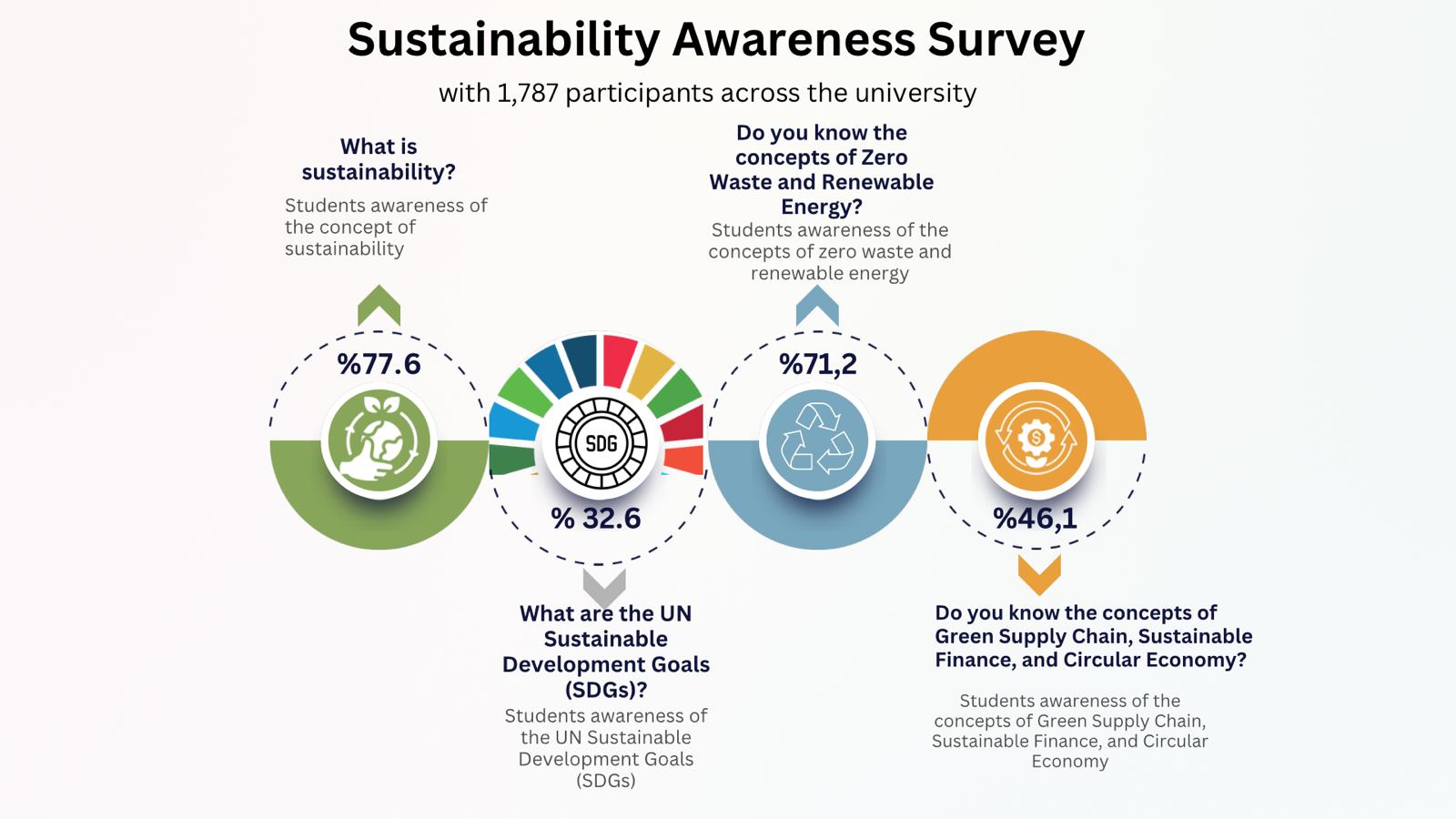
Sustainability Awareness Survey
SURKAM has conducted SDG Literacy and Sustainability Awareness Surveys across the university. The survey has measured students’ understanding of the SDGs, their perception of sustainability issues, and their engagement with sustainability-related activities.
Findings have been analyzed by SURKAM and incorporated into the University’s Sustainable Development Annual Report and SDG-specific reports, strengthening data-driven decision-making and institutional accountability.
This systematic assessment demonstrates the University’s commitment to continuously improving SDG education in alignment with global standards.
Related Links & Reports:
UNAI Membership
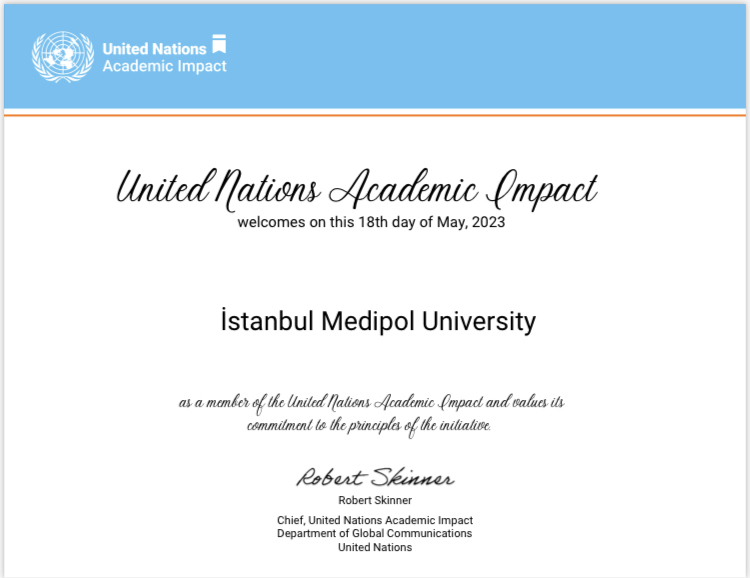
Istanbul Medipol University is a proud member of the United Nations Academic Impact (UNAI), an initiative that brings together higher education institutions from around the world to support the United Nations in advancing peace, human rights, sustainability, and social responsibility.
With more than 1,400 member institutions across 145 countries, UNAI promotes a global culture of intellectual cooperation. As a member, Istanbul Medipol University aligns its academic, research, and community activities with the UN’s ten guiding principles, focusing on quality education, human rights, sustainability, capacity development, and intercultural dialogue.
Through this membership, the University contributes to UN-led initiatives, participates in thematic networks, and implements annual activities that further the goals of the 2030 Agenda. UNAI membership also strengthens Medipol’s global visibility, fostering partnerships with international universities, civil-society organizations, and policy actors working toward shared sustainable development objectives.
- Istanbul Medipol University Policy on Partnerships for Sustainable Development and Goals
- Istanbul Medipol University Education Policy
- 2024 Signed Protocols
- UNSDSN
- Vocational Qualifications Authority Of Türkiye
- SURKAM
- SURKAM Courses
- SDG Related Courses
- SDG 17 Report
- Sustainable Development Report (2021 & 2022)
- Sustainable Development Report 2023
- Istanbul Medipol University Carbon Footprint Calculation
- Social Contribution Projects
- MEBIS