
THINGS TO DO

Women earn 10 to 30 per cent less than men for the same work. Pay inequality persists everywhere. Voice your support for equal pay for equal work.

Find a Goal 5 charity you want to support. Any donation, big or small, can make a difference!

Be aware of gender stereotypes. Recognize them, avoid them and educate others about them.

Stand up against harassment. Whenever you see or become aware of harassment, whether in the workplace, streets, home or the online space, raise your voice against it.

Find female mentors/leaders. Ensure that some of your role models or mentors are women. There’s a lot you can learn from women in positions of authority.

Share the workload at home. Sharing domestic responsibilities ensures the work burden doesn’t fall only on one person and instills the value of gender equality and essential life skills in children.

Stay informed. Follow your local news and stay in touch with the Global Goals online or on social media at @TheGlobalGoals.
2024 Report

2024 Report Poster
SHOW REPORT

Istanbul Medipol University‘s Commitment to SDG 5

Gender Equality

Istanbul Medipol University is committed to promoting gender equality as a fundamental institutional value and a key component of its sustainable development strategy. Guided by the UN SDG 5, Medipol works to ensure equal access, participation, and opportunity for all members of its community; students, academics, and administrative staff alike.

Through its Gender Equality Policy, which was updated in 2024, Medipol ensures fair representation, equal opportunities, and the prevention of gender-based discrimination across all academic and administrative units. The Office of Ombudsman of Anti-Discrimination and Equality operates as a dedicated mechanism to monitor equality practices, guide institutional processes, and handle reports related to discrimination with confidentiality and transparency.

Medipol also hosts the UNESCO Chair on Legal Protection of Women and Education of Women Entrepreneurs, which promotes women’s participation, legal awareness, and empowerment through education and research. Gender-related data are systematically monitored through national and internal information systems to ensure transparency, accountability, and continuous improvement.

In alignment with its quality and accreditation framework, Medipol integrates gender equality principles into teaching, governance, and community engagement. Faculty-based initiatives, outreach projects, and student-led communities including social contribution and sustainability clubs play an active role in promoting gender awareness, leadership, and inclusion across campus life.

Through mentoring programs, awareness campaigns, and collaborations with public institutions, NGOs, and local authorities, Istanbul Medipol University continues to advance the visibility and empowerment of women in higher education, research, and innovation.

By aligning its actions with the UN Sustainable Development Goal 5, Istanbul Medipol University reaffirms its dedication to building an inclusive, equitable, and empowering academic environment for all.

Gender Equality at Istanbul Medipol University

Istanbul Medipol University maintains a comprehensive and actively implemented Gender Equality Action Plan, reflecting its institutional commitment to SDG 5 and to international best practices in inclusive higher education governance. The Plan was revised and strengthened in 2024 to ensure alignment with evolving national legislation, global standards, and the University’s strategic priorities.

Policy Framework

The Action Plan operates in conjunction with the University’s formal Gender Equality Policy, which defines principles of equal opportunity, non-discrimination, inclusive participation, and gender-sensitive governance. Together, these documents establish a coherent framework for:

  • Promoting balanced representation in academic and administrative units,
  • Strengthening gender-sensitive institutional culture,
  • Preventing discrimination, harassment, and inequality,
  • Improving transparency in recruitment, promotion, and decision-making,
  • Expanding training, awareness, and capacity-building programs.

Gender Equality in Admissions, Enrolment, and Student Progression

Istanbul Medipol University maintains a robust and data-driven framework to monitor gender equality across all stages of the student lifecycle including applications, admissions, enrollment, retention, and graduation. This framework aligns closely with national higher education regulations and the University’s institutional commitment to SDG 5.

Centralized Data Collection Through MEBIS

The University’s comprehensive student information system, MEBIS, records all academic and administrative data, including gender-disaggregated information on:

  • Application numbers,
  • Admissions and placement results,
  • Enrolment and registration,
  • Progression from year to year,
  • Graduation and completion rates.

MEBIS enables continuous monitoring, annual reporting, and longitudinal comparison, allowing academic units and senior management to evaluate gender representation across all programmes.

National Data Integration

For students placed through national central examinations, Medipol reviews gender-segmented data from YÖK Atlas, the official higher education analytics platform of Türkiye. This provides accurate insight into national application patterns and gender representation across academic fields.

International Student Admissions at Istanbul Medipol University

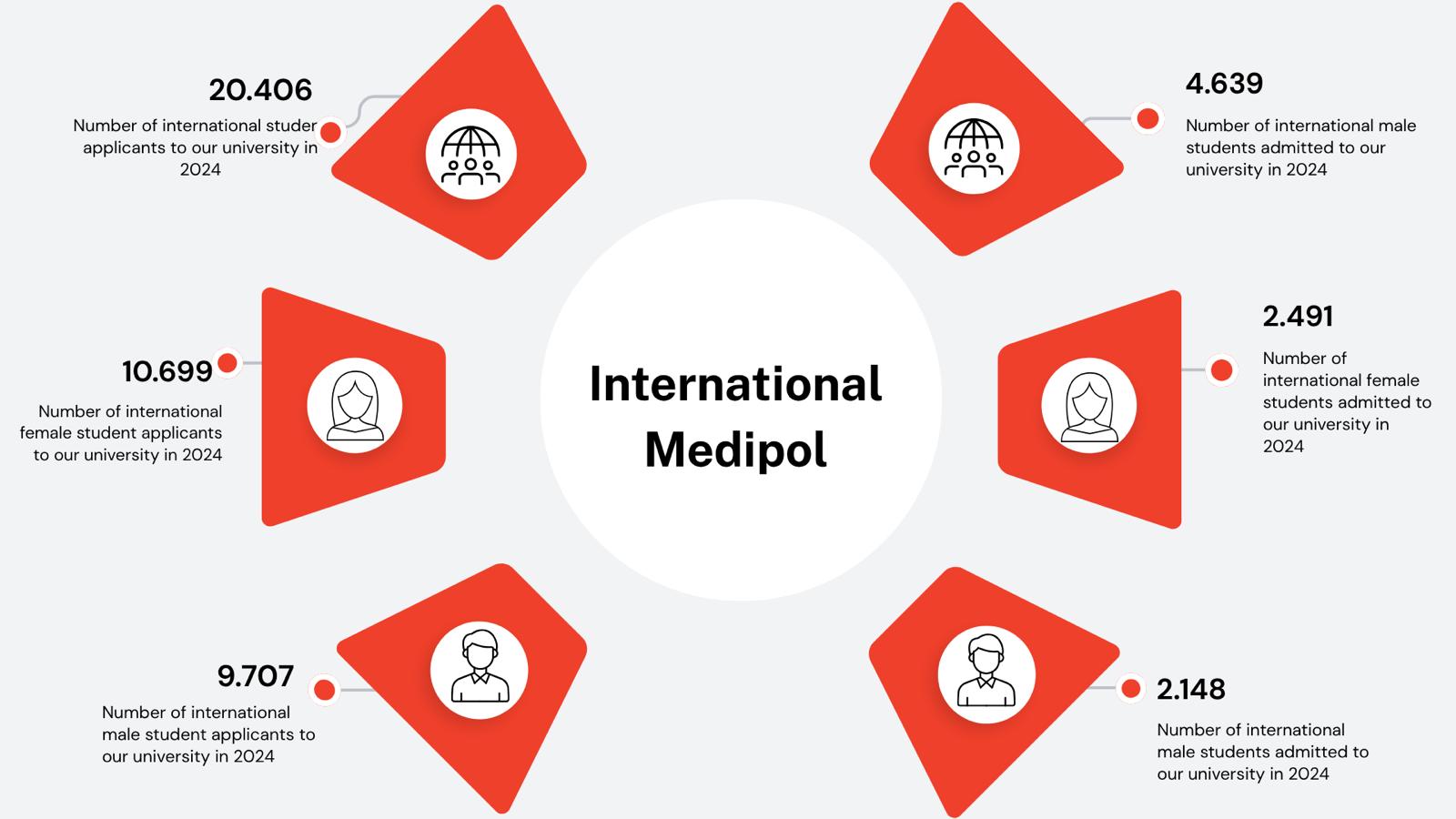
Because international student recruitment is conducted directly by the University, all international applications, acceptance rates, scholarship decisions, and enrolments are monitored internally. Gender-segmented dashboards allow the University to evaluate representation across countries and programmes.

These mechanisms ensure that gender balance is regularly assessed and that improvement actions are systematically integrated into faculty planning.

The University publishes high-level statistics through “Medipol at a Glance”, an annual report that provides gender-related insights across faculties and programs.

Through the combined use of national platforms, institutional information systems, accreditation mechanisms, and transparent reporting tools, Istanbul Medipol University maintains a strong, evidence-based system for tracking gender equality and ensuring continuous improvement across all academic processes.

Encouraging Applications by Women in Underrepresented Fields

Istanbul Medipol University actively encourages women to apply to academic programs in which they have been historically underrepresented. This commitment is embedded within the University Gender Equality Policy, Gender Equality Action Plan, International Student Directive and the institutional work coordinated by the Office of the Ombudsman for Anti-Discrimination and Equality.

The University implements targeted awareness campaigns, school outreach activities, open-day programs, and faculty-specific information sessions designed to increase female participation in these areas. Academic units collaborate with student clubs and SURKAM to highlight successful female role models, organize mentoring activities, and provide guidance to prospective female students. Data on female application, enrollment, and progression rates are regularly monitored through YÖK Atlas and internal systems (MEBIS) to assess progress and to strengthen evidence-based strategies that promote gender-balanced student recruitment.

Through these integrated efforts, Medipol ensures an inclusive admissions environment where women are informed, encouraged, and supported to pursue disciplines where gender gaps continue to exist—fully aligned with its institutional equality goals and SDG 5.

×

Women's Access Schemes

Istanbul Medipol University implements a wide range of outreach, mentoring, and empowerment programs designed to support women and girls in the community. These initiatives reflect the University’s strong commitment to SDG 5, to inclusive education, and to advancing women’s participation in social, academic, and professional life.

UNESCO Chair: Legal Protection of Women and Education of Women Entrepreneurs

The University hosts the UNESCO Chair on Legal Protection of Women and Education of Women Entrepreneurs, which plays a central role in designing and delivering programmes that promote legal literacy, awareness of rights and protection mechanisms, entrepreneurship education, gender-based discrimination training, and research that strengthens gender-related knowledge. The Chair collaborates with national and international partners, civil society organizations, and academic units to expand impact and institutional expertise.

Student Clubs as Catalysts for Women’s Empowerment

Several student organizations lead outreach and empowerment activities targeting women and girls:

  • Community and Women’s Club: Organizes seminars, awareness sessions, volunteering activities, and community-based projects focused on women’s rights, education, health, and empowerment.
  • Awareness Society: Conducts workshops and campaigns addressing gender equality, discrimination prevention, safe living, and social participation.
  • Sustainable Development Society: Promotes women’s involvement in sustainability, inclusive leadership, climate justice, and SDG-oriented skills, frequently collaborating with schools, municipalities, NGOs, and local communities.

Mentorship and Academic Support

Faculty members and academic advisors provide mentorship, career guidance, and academic support to young women interested in higher education pathways, scientific fields, entrepreneurship, and leadership roles. These activities help build confidence, address structural barriers, and support long-term professional development.

Women’s Mentoring Schemes

Istanbul Medipol University implements structured women’s mentoring schemes designed to strengthen the academic, professional, and personal development of female students. These schemes are coordinated across multiple academic units, student support services, and research centers, ensuring wide participation and sustainable impact.

University-wide Mentoring and Advisory Programs

Several faculties—particularly in health sciences, engineering, pharmacy, and social sciences—run formal mentoring programs where female academics support female undergraduate and graduate students in academic planning, research development, career orientation, and leadership skills. These faculty-led programs ensure continuity throughout the academic year and include one-to-one meetings, group mentoring sessions, academic skill-building workshops, and research-based guidance.

SURKAM & Gender Equality–Focused Mentoring Activities

Through SURKAM’s Gender Equality initiatives, the University implements thematic mentoring activities aligned with SDG 5, focusing on strengthening female participation in leadership, entrepreneurship, sustainability research, and community engagement. These activities include peer-mentoring circles, networking sessions, academic career advice, and role-model meetings.

Istanbul Medipol University supports women’s academic, professional, and leadership development through structured mentoring and empowerment programs coordinated under SURKAM and its Gender Equality Working Group. These programs form part of the University’s commitment to SDG 5 and are aligned with institutional equality policies and national frameworks.

SURKAM’s Gender Equality Working Group leads the design and implementation of annual mentoring programs aimed at strengthening women’s participation in academic life, research ecosystems, and leadership pathways. The mentoring scheme pairs female students with experienced faculty members and professional mentors, supporting career planning, research development, scientific publishing, leadership skills, and transition-to-work processes. Regular workshops, one-to-one sessions, and networking meetings help participants build confidence, expand professional networks, and engage in interdisciplinary collaboration.

In addition to the Gender Equality Working Group, SURKAM coordinates cross-unit working groups focusing on Women’s Leadership, Gender-Sensitive Academic Culture, and Inclusive Campus Practices. These groups monitor institutional data, identify structural barriers affecting women’s career progression, and develop action plans to strengthen gender equality across the university. Insights from these groups directly inform quality processes, university policies, and annual SDG reporting.

Together, SURKAM and its working groups ensure that women’s mentoring at Istanbul Medipol University is not limited to individual support, but operates as a structured, data-informed, institution-wide system that advances women’s empowerment and contributes to the broader SDG 5 framework.

Ombudsman Mentoring & Guidance for Female Students

The Office of the Ombudsman for Anti-Discrimination and Equality, while primarily a rights-protection unit, also provides advisory support to female students seeking guidance on equality, discrimination, safe campus procedures, and institutional rights. These sessions help strengthen confidence and encourage active participation in academic life.

Student Clubs & Community-Based Mentoring

Women-focused student clubs—including the Community and Women’s Club, Social Contribution Club, and Health Sciences clubs—organize mentoring sessions led by senior female students and alumni. These programs introduce first-year students to university life, study skills, academic networks, volunteering opportunities, and leadership pathways.

Selected Projects and Initiatives

Policy and Mechanisms on Discrimination, Harassment and Violence

Istanbul Medipol University maintains a comprehensive institutional framework to prevent and address discrimination, harassment, mobbing and all forms of violence, in line with national legislation and its commitment to SDG 5.

The University’s approach is based on clearly defined ethical codes, human resources policies and disciplinary regulations that prohibit discriminatory behaviour on the grounds of gender, disability, language, ethnicity, religion, belief, political opinion or any other personal characteristic. These regulations apply to both academic and administrative staff as well as students and are communicated through official directives, internal regulations and the University website.

Office of the Ombudsman for Anti-Discrimination and Equality

This Office provides an independent and confidential mechanism for reporting and examining allegations related to discrimination, harassment or unequal treatment. It evaluates applications, advises university units on appropriate procedures, follows up on cases in coordination with relevant boards and, when necessary, refers matters to disciplinary authorities in accordance with institutional and national regulations. The Directive of the Ombudsman for Anti-Discrimination and Equality was officially established in 2021 to ensure institutional compliance with equality, ethics, and non-discrimination principles.

Human Resources & Staff-Oriented Mechanisms

The University’s Human Resources Policy is committed to maintaining an equitable, respectful and safe working environment. It reinforces zero tolerance for unethical behaviour and ensures accessible complaint channels for all staff members.

Student Support Channels

For students, the Student Affairs Department, SKS, and the Psychological Counselling and Guidance Unit provide advisory support, safe referral mechanisms, and assistance in cases related to discrimination, harassment or emotional well-being.

Awareness & Training Activities

Regular seminars, orientation sessions and thematic trainings raise awareness about rights, institutional procedures, reporting channels and available support mechanisms. Through this integrated structure, Istanbul Medipol University aims to sustain a safe, fair and inclusive campus environment for all members of its community.

Maternity and Paternity Rights at Istanbul Medipol University

Istanbul Medipol University upholds comprehensive maternity and paternity rights in full compliance with Türkiye’s national legislation—most notably Labor Law No. 4857, Article 74—and other relevant regulatory provisions governing parental leave and protections for working parents. These rights support the University’s commitment to gender equality, work–life balance, and employee well-being, fully aligned with SDG 5.

Maternity Leave Framework

In line with Article 74 of Labor Law No. 4857, female employees at Istanbul Medipol University are entitled to:

  • 16 weeks of maternity leave (8 weeks before and 8 weeks after birth),
  • Additional 2 weeks of prenatal leave in cases of multiple pregnancy,
  • The right to transfer part of the prenatal leave to the postnatal period upon medical approval,
  • Unpaid leave options following maternity leave, as regulated by law,
  • Legally guaranteed breastfeeding breaks (“süt izni”),
  • Protection against dismissal due to pregnancy or childbirth.

The University ensures transparent processing of all maternity-leave procedures through the Human Resources Department.

Paternity Leave Framework

Male employees are granted parental rights and paid paternity leave in accordance with national legislation and applicable personnel regulations. These include:

  • Paid paternity leave following the birth of a child,
  • Additional leave options based on relevant public personnel rules,
  • Flexibility for balancing professional duties and new parental responsibilities,
  • Procedural support by the Human Resources Department for smooth implementation.

The University promotes active fatherhood as part of its equality-oriented institutional culture.

These commitments are reviewed regularly and documented in the University’s SDG 5 reporting processes, ensuring transparency and continuous improvement.

Gender-Based Graduation Patterns

Istanbul Medipol University systematically monitors gender-based student progression, retention, and graduation rates through the University’s integrated data management system, MEBIS. This system collects detailed, gender-disaggregated data for all programmes, enabling the University to track the likelihood of female and male students graduating on time, progressing through their studies, and completing degree requirements.

Institutional Monitoring and Data Analysis

Gender-disaggregated indicators are reviewed annually by:

  • Faculty and Program Quality Commissions,
  • Quality Committee,
  • Student Affairs and academic advising units,
  • SURKAM within the scope of SDG monitoring,
  • Gender Equality Working Group.

These analyses help identify whether any measurable gender attainment gap exists across departments, faculties, or levels of study. Findings feed directly into annual SDG 5 Reports, Quality Reports, and internal evaluations.

Mechanisms to Address and Prevent Graduation Gaps

If potential disparities are observed, Istanbul Medipol University implements targeted interventions through the following structures:

Academic Support Schemes:

  • Individual and group academic advising for students in risk categories,
  • Early-warning and follow-up systems for absenteeism, low performance, or disengagement,
  • Flexible assessment options and make-up exams when justified.

Psychological and Social Support:

  • Psychological Counselling and Guidance Services offering tailored support for academic, emotional, and personal challenges,
  • Specialized counselling for female students balancing caregiving responsibilities, employment, or socioeconomic difficulties.

Gender Equality–Focused Mechanisms:

  • Implementation of the Gender Equality Policy and Gender Equality Action Plan,
  • Support from the Office of the Ombudsman for Anti-Discrimination and Equality to ensure fair treatment and prevent discriminatory barriers,
  • Collaboration with student clubs that promote women’s participation in academic, social, and leadership domains.

Istanbul Medipol University’s commitments, policies, and annual progress toward gender equality are systematically documented and publicly reported in the SDG 5: Gender Equality Report prepared by SURKAM.

Policy Ensuring Protection

Istanbul Medipol University upholds a strong, rights-based framework that guarantees protection from retaliation for any student or staff member who reports discrimination, harassment, inequality of treatment, or violations of institutional equality principles. This protection is explicitly embedded in the University’s Directive of the Office of the Ombudsman for Anti-Discrimination and Equality, the Gender Equality Policy, and relevant Human Resources and Student Rights regulations.

Non-Retaliation Principle

According to the Ombudsman Directive, individuals who submit a complaint or provide information related to discrimination are protected from:

  • negative academic consequences,
  • unfair grading or assessment practices,
  • exclusion from courses, labs, or academic opportunities,
  • employment-related disadvantages,
  • unjust changes in duties or working conditions,
  • denial of rights, benefits, or access to services,
  • any form of pressure, intimidation, or retaliation.

This principle applies equally to students, academic staff, and administrative personnel.

Confidential and Impartial Reporting Mechanism

The Ombudsman for Anti-Discrimination and Equality receives applications in a strictly confidential, impartial, and non-hierarchical manner. The Directive ensures that:

  • reporting a concern cannot result in disciplinary disadvantage,
  • the individual’s identity is protected throughout the process,
  • retaliation attempts are themselves subject to disciplinary procedures,
  • all units must cooperate with the Ombudsman while safeguarding the complainant.

The Ombudsman may intervene formally or informally, request corrective action, make recommendations, and ensure institutional follow-up.

Academic and Administrative Safeguards

To prevent educational or employment disadvantage, the University provides:

  • safe application channels coordinated by the Ombudsman,
  • advisory support through Psychological Counselling Services,
  • Human Resources guidance ensuring fair treatment of staff,
  • oversight mechanisms under the Quality Assurance System to detect systemic risks,
  • integration of non-retaliation principles into the Gender Equality Action Plan and annual SDG reporting.

These measures ensure that students continue their education without disruption and that staff maintain their employment and career progression without fear of negative consequences.

  • Optimal Handover Optimization in Future Mobile Heterogeneous Network Using Integrated Weighted and Fuzzy Logic Models 01.01.2024
  • Gender and Age Trends in HIV Incidence in Türkiye between 1990 and 2021: Joinpoint and Age–Period–Cohort Analyses 01.08.2024
  • Gender inequality in genitourinary malignancies clinical trials leadership 01.12.2024
  • Global Andrology Forum Clinical Practice Guidelines on the Management of Premature Ejaculation 01.01.2024
  • Investigation of central auditory processing performance in individuals with and without stuttering 01.06.2024
  • Effects of epidural steroid injections on menstrual cycle in women: An observational study 01.04.2024